
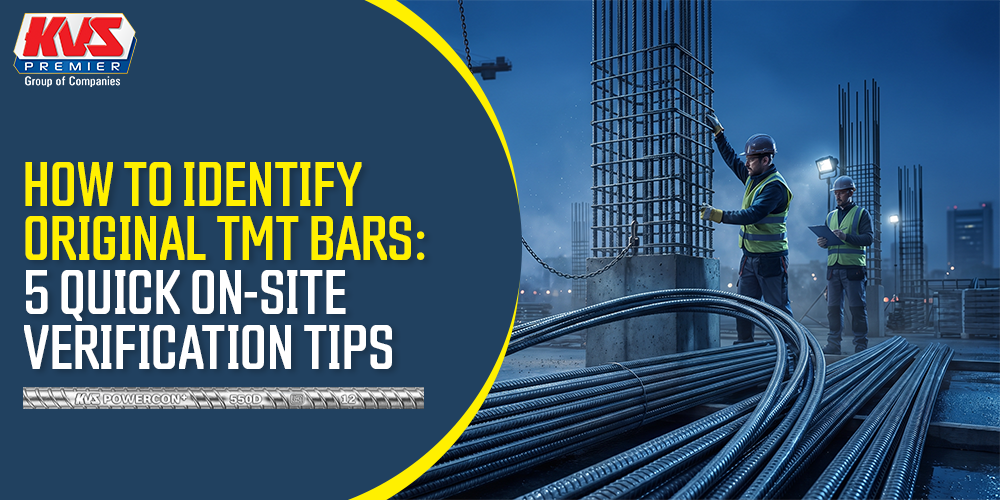
How to Identify Original TMT Bars: 5 Quick On-Site Verification Tips
To identify original TMT bars on-site, check ISI/BIS embossing, rib pattern consistency, Mill Test Certificate (MTC), bend strength, and weight per metre as per IS 1786 standards. Always source from a certified tmt bars manufacturer and trusted tmt manufacturers to ensure quality and safety.
Why On-Site TMT Bar Verification Matters
Substandard and duplicate steel has become a growing concern in construction across India. With many tmt manufacturers in the market, verifying quality on-site is essential before using any material.
Poor-quality bars may look similar but perform very differently under stress. They can reduce load-bearing capacity, develop cracks over time, and fail during heavy loads or seismic conditions. This is why working with a trusted tmt bars manufacturer and performing quick on-site checks is important.
Even when sourcing from reputed tmt manufacturers, basic verification helps ensure long-term structural safety.
1. Check ISI Mark and Brand Embossing
Original TMT bars always carry permanent embossing that includes the ISI/BIS mark, steel grade such as Fe500 or Fe500D, and the manufacturer’s name. This marking is created during the rolling process and cannot be replicated through paint or surface printing.
When inspecting on-site, ensure the embossing is raised, clear, and evenly spaced along the bar. If the marking appears faded, inconsistent, or missing, it is a strong indication that the product may not come from a certified tmt bars manufacturer. Authentic embossing is one of the simplest yet most reliable checks.
2. Inspect Rib Pattern and Surface Quality
The rib pattern on TMT bars plays a crucial role in bonding with concrete. High-quality bars produced by leading tmt manufacturers have uniform, well-defined ribs with consistent spacing and depth.
Visually inspect multiple bars from the same batch. If you notice uneven ribs, flat sections, or surface defects such as cracks or scaling, it may indicate poor manufacturing control. Advanced rolling technologies used by reputed manufacturers ensure consistency, which directly impacts structural strength.
3. Verify the Mill Test Certificate (MTC)
The Mill Test Certificate is a critical document that confirms the quality and compliance of the steel. It includes details such as heat number, chemical composition, yield strength, tensile strength, and BIS certification.
Always cross-check the heat number mentioned in the MTC with the number embossed on the bar. A genuine tmt bars manufacturer will always provide this certificate, and any mismatch should be treated as a serious warning.
4. Perform Bend and Rebend Test
The bend and rebend test is one of the most practical ways to check ductility on-site. High-quality TMT bars have a strong outer surface with a flexible inner core, allowing them to bend without cracking.
When tested, a good bar from trusted tmt manufacturers will show smooth bending and retain its structural integrity without visible fractures. Bars that crack or show surface damage during bending indicate brittleness and poor heat treatment, making them unsafe for construction use.
5. Check Weight Per Metre
Weight consistency is a direct indicator of quality and strength. According to IS 1786, each bar diameter has a standard weight—for example, a 12mm TMT bar should weigh approximately 0.888 kg per metre.
On-site, measure and weigh random samples from the bundle. If the weight is significantly lower than standard values, it indicates under-rolling, where less steel is used to reduce cost. A reliable tmt bars manufacturer always maintains proper weight tolerance to ensure structural safety.
Always Buy from Verified Sources
While on-site checks are important, sourcing from the right supplier is equally critical. Always verify BIS certification, manufacturer credentials, and supply chain authenticity before purchasing.
You can also verify BIS license details through official Indian government portals. Trusted platforms like kvspremier.com focus on supplying materials from verified tmt manufacturers, helping reduce the risk of counterfeit or substandard products.
Final Takeaway
Identifying original TMT bars does not require complex tools, but it does require attention to detail. A combination of proper sourcing, documentation, and quick on-site checks can prevent major structural failures.
Choosing a certified tmt bars manufacturer, verifying quality through IS standards, and performing simple inspections ensures your construction remains strong, safe, and reliable with trusted tmt manufacturers.
FAQs
1. What are the common signs of fake TMT bars on-site?
Fake TMT bars usually have unclear or missing embossing, uneven rib patterns, and inconsistent thickness. In many cases, they may also show early rust or surface defects. Another major sign is the absence of proper documentation like the Mill Test Certificate. These indicators suggest poor manufacturing quality and should not be ignored before using the material.
2. How does rib pattern affect TMT bar performance?
Rib patterns improve the bonding between steel and concrete, which is essential for structural strength. Uniform ribs ensure better grip and load distribution within reinforced concrete structures. Poor or irregular rib design reduces bonding efficiency, which can lead to cracks and structural weakness over time, especially under heavy loads.
3. Can TMT bar quality be checked without lab testing?
Yes, basic on-site checks like visual inspection, embossing verification, bend testing, and weight measurement can help identify quality. However, for large-scale projects, laboratory testing is recommended for complete assurance. These on-site methods act as quick filters but should be supported by proper documentation from the manufacturer.
4. Why is IS 1786 important for TMT bars in India?
IS 1786 is the standard that defines the quality, strength, and chemical composition of TMT bars in India. It ensures that the steel used in construction meets safety and performance requirements. Buying bars that comply with this standard from a certified tmt bars manufacturer reduces the risk of structural failure.
5. What mistakes should buyers avoid while purchasing TMT bars?
Buyers often make the mistake of choosing products based only on price, ignoring certifications, and not verifying weight or documentation. Another common issue is purchasing from unverified suppliers. To avoid these risks, always choose trusted tmt manufacturers, verify BIS certification, and perform basic on-site checks before use.
Leave A Comment