
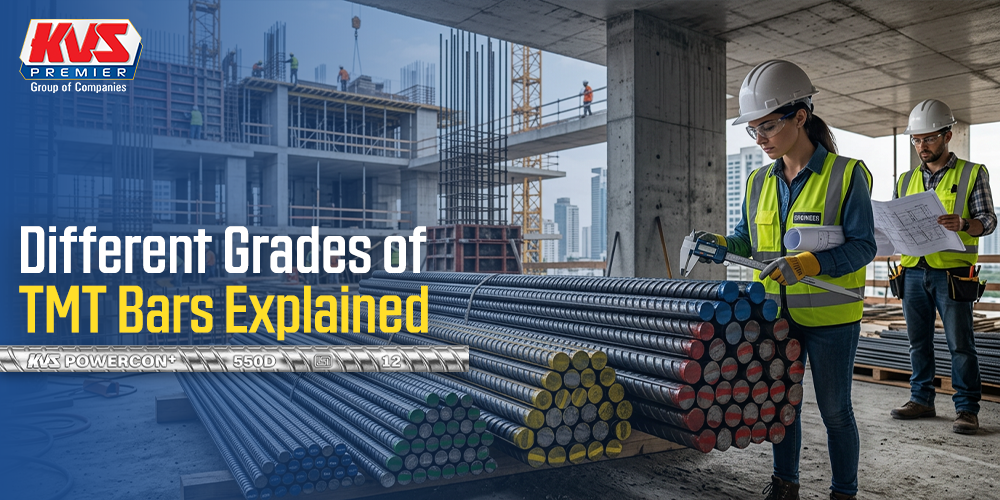
Different Grades of TMT Bars Explained
If you’re
planning a build, one of the most important decisions you’ll make isn’t visible
once the plaster goes on: it’s the grade of steel inside your walls and
columns. TMT bars come in several grades, each suited to different loads,
climates, and seismic risks, and picking the wrong one can compromise a
structure long before it ever shows a crack. In this guide, we break down the
common TMT bar grades, what the letters and numbers actually mean, and how to
choose the right one, using our own KVS POWERCON+ range, among the best TMT bars available
today, as a real world example of how a certified manufacturer grades and tests
its bars.
What
Are TMT Bars and Why Does Grade Matter?
TMT stands
for Thermo Mechanically Treated steel. The bars are quenched rapidly after hot
rolling, then allowed to temper using their own residual heat, which gives them
a hard outer rim and a soft, ductile core. That combination is what makes TMT
bars strong enough to carry heavy structural loads while still being flexible
enough to bend and weld on site without cracking.
The
“grade” of a TMT bar refers to its guaranteed minimum yield strength,
tested and classified under IS 1786:2008, the Indian Standard that governs high
strength deformed steel bars for concrete reinforcement. Higher grade bars
carry more load per unit of cross section, so grade selection directly affects
how much steel a structure needs and how well it performs under stress.
Understanding
the Common TMT Bar Grades
Under IS
1786:2008, TMT bars are broadly
classified by their yield strength in megapascals (MPa), followed by a suffix
that describes ductility:
- Fe
415 / Fe 415D: An older, lower strength grade
once common in residential construction, now largely phased out for
structural work in favour of higher grades.
- Fe
500: A mid strength grade offering a
good balance of strength and cost for general construction.
- Fe
500D: The “D” denotes
higher ductility (minimum elongation and a stricter UTS/YS ratio) than
standard Fe 500, giving better performance under sudden or cyclic loads.
- Fe
500SD: “SD” stands for
Superior Ductility. This grade goes further than Fe 500D, with tighter
tolerances on elongation and the tensile to yield ratio, making it well
suited to earthquake prone regions.
- Fe
550 / Fe 550D: A higher strength grade that
reduces the total steel tonnage needed in a structure while still meeting
ductility requirements, often specified for high rise and heavy load
projects.
The pattern
to remember is simple: the number indicates strength, and the “D” or
“SD” suffix indicates how much the bar can stretch and absorb energy
before failure, a critical property during earthquakes, when structures are hit
with sudden, unpredictable loading.
Fe
500D vs Fe 500SD vs Fe 550D: Key Differences
These three
grades are the ones most commonly compared during project specification:
- Fe
500D balances strength and ductility
for general reinforced concrete work, including residential buildings,
small commercial structures, and standard infrastructure.
- Fe
500SD raises the ductility bar
further, with a guaranteed higher UTS/YS ratio and elongation, making it a
stronger choice for buildings in seismic zones or structures with
strategic or public importance.
- Fe
550D delivers a higher yield strength
than the 500 series grades, which can reduce the quantity of steel
required for the same load bearing capacity, while still meeting ductility
norms for demanding, high rise, or industrial projects.
In practice,
the right grade depends on the structural engineer’s load calculations, the
seismic zone of the site, and the type of structure being built. A small
residential extension has very different requirements from a multi storey commercial
tower.
Which
TMT Grade Should You Choose for Your Project?
A few
practical guidelines help narrow the decision:
- Residential
and low rise buildings in low
seismic zones often work well with Fe 500D, balancing cost and
performance.
- Seismic
zones, high rise buildings, bridges, and public infrastructure typically call for Fe 500SD or Fe 550D, where superior
ductility and energy absorption directly affect structural safety.
- Coastal
or high humidity regions benefit
from grades with strong corrosion resistance, regardless of strength
class, to protect long term durability.
Always
confirm the final specification with a structural engineer, since grade
selection also interacts with bar diameter, spacing, and the overall
reinforcement design. It’s never just one number in isolation.
How
We Test Grade Quality at KVS Premier
Genuine grade
compliance isn’t just a label, it’s backed by testing. As one of the
established TMT bars manufacturers
in India,
we verify yield strength, ultimate tensile strength, the UTS/YS ratio, and
elongation percentage against IS 1786:2008 before a batch ever leaves our
plant. We recommend buyers ask any supplier for test certificates and BIS
marking as standard practice, rather than relying on branding alone, since
mismatched or under graded bars are one of the most common, and most dangerous,
quality issues in the Indian construction market.
KVS
POWERCON+: The Grades We Manufacture
At KVS
Premier Group, through our manufacturing arm Kashi Vishwanath Steels Pvt. Ltd.,
we have been producing TMT bars and structural steel from our Kashipur,
Uttarakhand facility since 1985. Our flagship product line, KVS POWERCON+ TMT
Bars are manufactured in Fe 500SD and Fe 550D/550SD grades in accordance with
IS 1786:2008 standards.
Our bars are
engineered with a higher UTS/YS ratio and guaranteed minimum elongation, which
allows them to absorb more energy when loaded beyond the yield point, the kind
of sudden loading experienced during earthquakes, cyclones, or other extreme
events. We build in excellent bond strength, corrosion resistance, fire
resistance, higher ductility, and strong bendability and weldability as core
characteristics, making KVS POWERCON+ 550D suited to both seismic and non
seismic construction, including structures of public and strategic importance.
We’re proud to offer what we consider the best TMT bar in India for
demanding projects, and we back that claim with certification, testing, and a
track record that spans four decades.
Why
We’re a TMT Company in India You Can Trust
Grade is only
half the equation. The manufacturer behind the bar matters just as much. When
evaluating any TMT company
in India,
look for BIS certification, transparent mechanical and chemical property data,
a track record with institutional or government clients, and consistent quality
control across batches. At KVS Premier Group, we count NTPC, Indian Oil, the
Ministry of Defence, and several state power and infrastructure corporations
among our long standing customers, the kind of institutional trust that
reflects consistent grade compliance over time and is central to why we
position our POWERCON+ range as a leading best TMT bar in India contender.
Frequently
Asked Questions
How
many TMT bar grades are there?
IS 1786:2008 covers several grades, including Fe 415, Fe 415D, Fe 500, Fe 500D,
Fe 500SD, Fe 550, and Fe 550D. Each grade differs in guaranteed yield strength
and ductility, and manufacturers choose which grades to produce based on demand
and application.
Which
TMT grade is best for earthquake prone areas?
Fe 500SD and Fe 550D grades are generally preferred in seismic zones because of
their higher ductility and superior energy absorption capacity under sudden
loading.
What
grades does KVS Premier Group manufacture?
We manufacture KVS POWERCON+ TMT bars in Fe 500SD and Fe 550D / 550SD grades,
certified to IS 1786:2008, at our Kashipur, Uttarakhand facility. It’s this
combination of certified grades and consistent testing that lets us call
POWERCON+ the best TMT bar in India for seismic zone construction, and one of
the best TMT bars for institutional projects generally.
Is
a higher TMT grade always the better choice?
Not necessarily. A higher-grade increases strength and ductility, but the right
choice depends on the structural engineer’s load calculations and the building
type. Over specifying can add unnecessary cost without a corresponding safety
benefit.
How
can I confirm a TMT bar’s grade before buying?
Ask the manufacturer for mill test certificates showing yield strength, UTS/YS
ratio, and elongation results against IS 1786:2008, and check that the bars
carry valid BIS certification. We provide this documentation for every batch of
KVS POWERCON+ bars.
Final
Thoughts
TMT bar grade
isn’t a technical footnote, it’s a core safety decision that shapes how a
structure behaves under real world stress. Understanding the difference between
Fe 500D, Fe 500SD, and Fe 550D helps you have an informed conversation with
your engineer and supplier. If you’re comparing certified options, our KVS POWERCON+
range in Fe 500SD and Fe 550D grades, built to be among the best TMT bars on the
market, is worth reviewing for your next seismic zone or high load construction
project.
Search
Recent Posts
Leave A Comment