
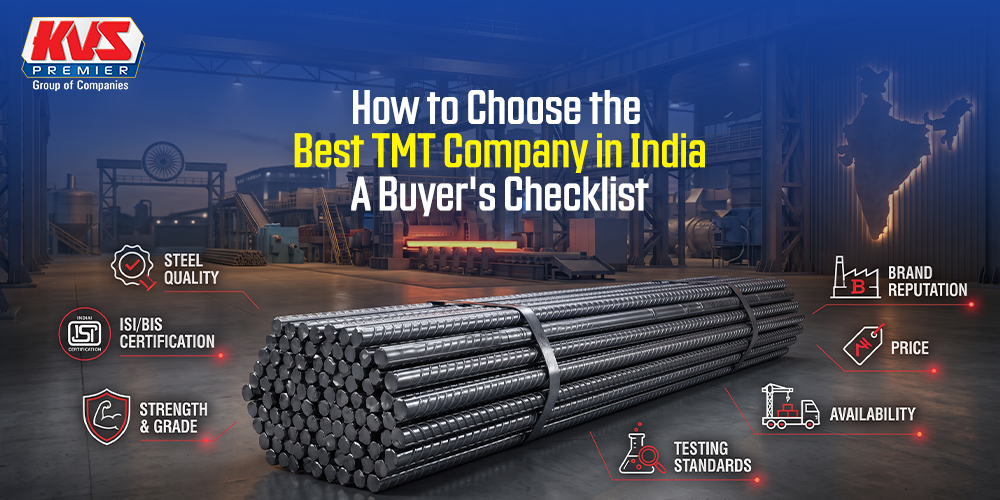
How to Choose the Best TMT Company in India: A Buyer's Checklist
At KVS Premier, we talk to builders, contractors, and procurement teams every week who are comparing TMT suppliers for an upcoming project. The questions they ask are almost always the same, so we put together this checklist to give you a clear, practical framework for evaluating any TMT company in India before you commit, not just the suppliers you’re already talking to.
Quick Answer
To choose the best TMT company in India, evaluate six things before placing an order: batch-level BIS certification, active ISO 9001, 14001, and 45001 status, a decade-plus track record in TMT manufacturing, the right grade for your project’s seismic zone and structural needs, dealer coverage near your site, and verifiable project references. Together, these checks give a complete picture of a supplier’s reliability before you commit.
Buyer’s checklist at a glance:
• Verify BIS certification down to the batch, using the manufacturer’s license number for that specific consignment
• Confirm ISO 9001, 14001, and 45001 status is current, since certifications can lapse or apply only to certain plants
• Look for a minimum 10 to 15 years of manufacturing history in the TMT segment specifically
• Match the bar grade to your project’s seismic zone and structural load requirements for the right balance of strength and ductility
• Review dealer and stockist coverage near your project site for realistic delivery timelines
• Ask for references from institutional, government, or large-scale projects
This guide walks through each of these checkpoints in detail, so you can evaluate any TMT company in India with confidence, whether you’re comparing quotes for a small residential build or sourcing steel for a large infrastructure project.
Why the Buying Decision Matters More Than It Seems
A TMT bar looks the same on paper regardless of who manufactures it: a grade number, a diameter, a price per kilogram. But the difference between a well-made bar and a poorly made one only shows up years later, when a structure is under real load. Substandard steel doesn’t fail on day one. It fails during a flood, an earthquake, or simply after two decades of stress the bar was never engineered to handle.
That’s why picking the best TMT bar company for your project isn’t a purchasing formality. It’s a structural decision. This checklist breaks down exactly what to verify before you sign a purchase order, so the decision is based on documentation and process, not just the lowest quote in your inbox.
Step 1: Confirm BIS Certification on the Actual Batch
Every legitimate TMT company in India should hold BIS (Bureau of Indian Standards) certification under IS 1786, the code that governs high strength deformed steel bars for concrete reinforcement. But certification at the company level isn’t the same as certification on the batch you’re buying.
Ask for:
• The manufacturer’s current BIS license number
• Batch specific test certificates (mechanical properties, chemical composition)
These documents help you verify the quality, specifications, and compliance of the TMT bars before making your purchase.
Step 2: Check for ISO Certifications, Not Just BIS
BIS certification confirms the product meets India’s structural steel standard. ISO certifications confirm something different: how consistently the manufacturer’s processes are managed.
Look specifically for:
• ISO 9001 — quality management systems
• ISO 14001 — environmental management
• ISO 45001 — occupational health and safety management
A manufacturer holding all three is signaling that quality control isn’t a one-time audit; it’s built into daily operations. This combination is one of the clearest ways to separate an established TMT company in India from a smaller operation cutting corners on process discipline.
Step 3: Evaluate Manufacturing Track Record
Thermo mechanical treatment, the process that gives TMT bars their strength and ductility, is sensitive to small variations in temperature, timing, and rolling speed. Manufacturers refine this process over years of production runs, not in their first few batches.
When comparing suppliers, ask:
• How long has the company been manufacturing TMT bars specifically, not just steel products generally?
• Can they show consistent output across different product lines (e.g., standard TMT bars, higher grade seismic bars, cold rolled variants)?
• Do they have documented case studies or project references you can verify?
A company with over a decade of focused TMT manufacturing experience has typically already resolved the process inconsistencies that newer entrants are still working through.
Step 4: Match the Grade to Your Project’s Seismic Zone
India is divided into seismic zones ranging from Zone II (low risk) to Zone V (high risk). Not every TMT grade performs equally well across all of them. A TMT company in India worth working with should be able to guide you on which grade fits your specific location, not just sell you whatever’s in stock.
Common considerations include:
• Fe 500D and Fe 550D grades offer higher ductility, which matters more in seismically active zones
• Cold rolled variants can offer different strength to flexibility ratios depending on the structural application
• Structural products like flats, rounds, channels, and angles need to be matched to load-bearing requirements, not just general construction use
If a supplier can’t explain why a particular grade suits your project, that’s worth treating as a gap in expertise, not just a sales limitation.
Step 5: Assess the Distribution and Delivery Network
Even the best steel doesn’t help your project if it arrives three weeks late. Before finalizing a supplier, map their distribution reach against your project location:
• Do they have dealers or stockists near your site, or will every order involve long-haul logistics?
• What’s their typical lead time for standard orders versus bulk orders?
• Have they supplied projects of similar scale to yours before?
A best TMT bar company on paper isn’t much use if their delivery timelines don’t match your construction schedule. This is especially important for large or phased projects where steel needs to arrive in coordinated batches, not all at once.
Step 6: Ask About Institutional and Government Project History
Government bodies, PSUs, and large infrastructure projects typically run their own vendor vetting process before approving a steel supplier. That vetting usually covers certification checks, quality audits, and delivery reliability testing that goes beyond what an individual buyer could easily verify on their own.
If a TMT company in India has a track record supplying power corporations, road transport bodies, or public works departments, that history is a useful proxy for due diligence that’s already been done by someone else. It doesn’t replace your own checks, but it’s a meaningful data point.
Step 7: Get Transparent, Verifiable Pricing
TMT and saria rates fluctuate with raw material costs, so any quote you receive should be time-stamped and tied to a specific date. Be cautious of suppliers who:
• Refuse to break down pricing by grade and quantity
• Push verbal quotes without written confirmation
• Pressure you into same-day decisions without documentation
A transparent supplier will confirm current rates through your authorized dealer or their sales team directly, and provide that confirmation in writing before you commit to a bulk order.
Putting the Checklist Together
Here’s the short version, if you’re comparing two or more vendors side by side:
• Certification check: BIS on the batch, plus ISO 9001, 14001, and 45001
• Track record check: minimum 10 to 15 years in TMT manufacturing specifically
• Grade fit check: the right grade for your seismic zone and structural load requirements
• Logistics check: dealer network coverage near your project site
• Reference check: institutional or government project history
Suppliers who score well across these areas are the ones worth shortlisting. A supplier who scores well on price alone, but weak on certification or track record, is a risk that tends to show up years after the building is finished, when it’s far more expensive to fix.
Final Thoughts
Choosing the best TMT company in India isn’t about finding the lowest price per kilogram. It’s about verifying that the steel going into your foundation, columns, and beams has been manufactured, tested, and certified to actually perform under load for decades. Use this checklist as a working document during vendor evaluation, and don’t skip the paperwork stage just because a sales conversation feels reassuring.
This is the same framework we hold ourselves to at KVS Premier, and we’d encourage you to run it against any supplier you’re considering, including us. If you’d like to see our BIS and ISO documentation, product range, or project references for yourself, our team is happy to walk you through them.
Frequently Asked Questions
1. What certifications should I check before choosing a TMT company in India?
Look for BIS certification under IS 1786 on the actual batch, along with ISO 9001, 14001, and 45001 certifications covering quality, environmental, and safety management. Ask for batch-specific test certificates, not just company-level credentials.
2. How many years of experience should the best TMT bar company have?
A minimum of 10 to 15 years of focused TMT manufacturing experience is a reasonable benchmark. Thermo mechanical treatment takes years to refine, so longer-established manufacturers typically show more consistent batch quality.
3. Does the TMT grade I need depend on my location?
Yes. India’s seismic zones range from Zone II to Zone V, and higher ductility grades like Fe 500D or Fe 550D are generally better suited to seismically active areas. A knowledgeable supplier should help match the grade to your zone.
4. How do I verify if a TMT company in India is reliable for large projects?
Check their institutional and government project history, since public sector vendors go through vetting processes covering certification, quality audits, and delivery reliability. A track record with PSUs or infrastructure bodies is a strong reliability signal.
5. What’s the biggest mistake buyers make when comparing TMT suppliers?
Prioritizing price per kilogram over certification and track record. Substandard steel often performs adequately at first and only fails years later under real structural load, by which point replacement is far more costly.
6. How can I get accurate, current pricing from a TMT company in India?
Rates fluctuate with raw material costs, so always request written, dated pricing confirmation from the manufacturer’s sales team or an authorized dealer rather than relying on verbal quotes or generic online estimates.
Leave A Comment