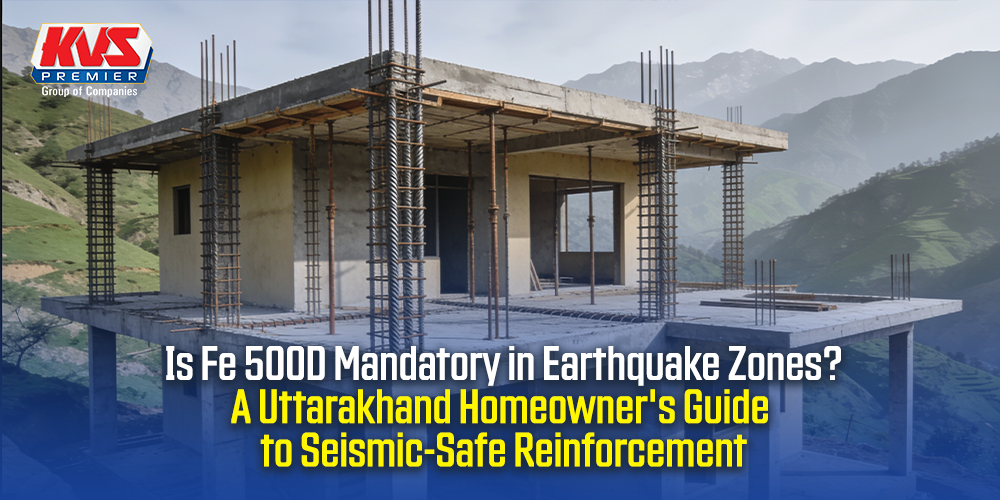
You have finally bought the plot. The mountains are in the background, the architect has shared the drawings, and the contractor is asking one quick question: “Which steel should I order?”
Someone nearby says, “Just use whatever is available.” Another says, “Fe 500D is a must in earthquake zones.” A third says, “Fe 500 is the same thing, why pay extra?”
If you are confused, you are in good company. Almost every homeowner in Uttarakhand faces this moment. Let’s settle it properly.
The Short Answer: Is Fe 500D Mandatory?
For a house in Uttarakhand’s seismic zones, Fe 500D is the grade most engineers specify, and the earthquake codes point firmly in its direction.
Here is how the rules fit together:
- Uttarakhand falls largely in Seismic Zones IV and V under IS 1893, India’s earthquake design standard. Check the exact zone for your plot, because it varies by district and town.
- The ductile detailing standard, IS 13920, applies to earthquake-designed reinforced concrete buildings. It requires reinforcement that meets set limits for elongation and strength ratio, and “D” grades like Fe 500D are made to meet them, and any reliable TMT bars manufacturer can supply them with test certificates.
- Whether Fe 500D is a legal requirement for your house depends on your sanctioned plan, local authority bylaws and your engineer’s design.
So “mandatory” may not be printed on every approval, but in Zones IV and V, ductile reinforcement is what the codes expect, and Fe 500D is the practical way to meet that. If your structural drawing says Fe 500D, that settles it for your site, and you can ask TMT bar manufacturers in Uttarakhand for that exact grade.
What Does “Fe 500D” Actually Mean?
You will see this name on every bundle tag, so it helps to read it like a label:
- Fe is the chemical symbol for iron, the base of steel.
- 500 is the minimum yield strength in megapascals (MPa), meaning the stress at which the bar starts to stretch permanently.
- D marks the ductile version, tested to stretch more before it breaks.
Read together, Fe 500D means a 500 MPa bar built to bend before it breaks, which is exactly what a shaking building needs.
Know Your Ground Before You Choose Your Steel
Uttarakhand is not one uniform risk map. Your steel decision should start with where you are building:
- Zone V areas: Higher Himalayan districts such as Chamoli, Rudraprayag, Uttarkashi, Bageshwar and Pithoragarh sit in the highest-risk category.
- Zone IV areas: Much of the rest of the state, including the Dehradun and Nainital regions, falls here.
- Slope and soil: A house on a steep hillside behaves very differently from one on a valley floor, even within the same zone.
The 1991 Uttarkashi and 1999 Chamoli earthquakes showed how badly buildings suffer when construction quality falls short. Many of today’s rules were shaped by those lessons.
Myth vs Fact: What Uttarakhand Homeowners Keep Hearing
Myth: “My neighbour’s house has survived for 30 years, so ordinary steel is fine.”
Fact: Surviving small tremors is not the same as surviving a major one. Earthquake safety is about the event that hasn’t happened yet.
Myth: “A thicker bar means a safer house.”
Fact: Safety comes from the right grade, the right spacing and the right detailing, not simply from more steel.
Myth: “Seismic-safe building costs a fortune.”
Fact: The extra cost of ductile steel and proper detailing is usually a small slice of the total build. Repairs and retrofitting cost far more.
Myth: “Hill homes are safer because they’re built on rock.”
Fact: Slopes bring their own risks, including landslides, uneven foundations and short column failures.
Where Steel Does Its Real Work, Stage by Stage
Picking the right grade is only half the job. A hill home needs good steel in the right places. Here is how it plays out as your house goes up.
1. Foundation and retaining walls
On slopes, your foundation fights soil pressure on one side and gravity on the other. Stepped footings and retaining walls need well-anchored reinforcement, because this is where a hill house faces stress for decades, not just in a quake.
2. Plinth band
A continuous reinforced belt around the house at plinth level, it ties walls together so the building moves as one unit. Many homeowners skip it to save money. Please don’t.
3. Columns and beams
This is the heart of an RCC frame. Columns must stay standing so people can get out, so engineers design them stronger than beams.
4. Lintel and roof bands
These hold walls and roof together and reduce the chance of walls falling outward.
5. Slabs and staircases
They carry floor loads and also pass sideways force through the structure. Poorly connected stair and slab steel can become a weak link.
Think of reinforcement as your home’s skeleton. In an earthquake, every bone has to stay connected to the next.
Hill-Specific Trouble Spots Most Homeowners Miss
Some damage in hill homes comes from design choices, not steel. Ask your engineer about these:
- Soft storey: An open ground floor for parking, with walls only above, makes the lower level far more flexible and vulnerable.
- Short column effect: On sloping sites, columns on the downhill side are taller than those uphill. Short, stiff columns attract more force and can fail suddenly.
- Heavy roofs: Thick concrete roofs and rooftop water tanks add weight at the top and increase sway.
- Irregular shapes: L-shaped plans, odd projections and large cantilevers concentrate stress at corners.
Good steel cannot fix a poor design, but a good design with the right steel can protect a family for generations.
Already Built? Retrofitting Is Possible
Many Uttarakhand homes were built before modern seismic codes. If you live in one, you are not powerless.
- Get a structural assessment. An engineer can check cracks, wall condition and frame connections.
- Consider strengthening. Options include adding bands, jacketing columns and bracing weak walls.
- Start with the riskiest parts. Open ground floors, old balconies and heavy water tanks deserve attention first.
Retrofitting usually costs less than rebuilding and can be done in phases.
6 Questions to Ask Your Engineer Before You Order Steel
Walk into the meeting with these, and you will get much clearer answers:
- Which seismic zone is my plot in, and which grade does the design assume?
- Does my plan have a soft storey or short columns because of the slope?
- Which bands (plinth, lintel, roof) are included in my drawing?
- Will ductile detailing under IS 13920 be followed on site, including stirrup spacing at column and beam ends?
- Is my foundation designed for the soil report of this exact plot?
- Who will inspect the reinforcement before concrete is poured?
If an answer sounds vague, that is your cue to ask again before the steel is ordered.
Choosing Your TMT Bars Manufacturer in the Hills
Once your engineer confirms the grade, the next question is who supplies it. A dependable TMT bars manufacturer gives clear answers about which grade suits your zone, shares its certification and testing details without hesitation, and stays reachable if questions come up mid-construction.
Supply reliability matters more than people expect in the mountains. Roads close during monsoon, and a project stuck without steel loses weeks. That is why many builders look for TMT bar manufacturers in Uttarakhand, or suppliers with strong regional delivery, instead of ordering from far away and hoping for the best.
How KVS Premier Can Help
Planning a home in Uttarakhand? KVS Premier can guide you on grade selection and supply planning for your project. Share your zone, building type and your engineer’s specification with the team, and discuss what suits your site before you commit. Whichever TMT bar company in Uttarakhand you consider, ask the same questions and expect the same openness.
Planning your home in Uttarakhand?
Share your zone and your engineer’s specification, and get a quote on KVS POWERCON TMT bars.
The Bottom Line
Fe 500D may not be printed as a rule on every plan, but in Uttarakhand’s earthquake belt it is the safest standard to follow. Pair it with a good design, a qualified engineer and careful site work, and your home has the best chance of standing strong.
You build a home once. Build it so you never have to worry about the ground beneath it again.
Frequently Asked Questions (FAQs)
1. Is Fe 500D compulsory for building a house in Uttarakhand?
It depends on your sanctioned plan, local bylaws and structural design. However, most of Uttarakhand lies in Seismic Zones IV and V, and earthquake codes expect ductile reinforcement. Fe 500D is the commonly specified grade, so follow your engineer’s drawing.
2. Which parts of a house matter most for seismic-safe steel?
Columns, beams, plinth and lintel bands, and the connections between them matter most. Earthquake damage often starts where parts of the structure join, so correct detailing is as important as the grade itself.
3. Is it safe to build on a slope in Uttarakhand?
Yes, with proper design. Sloping sites need a soil investigation, stepped or well-anchored foundations, retaining walls where needed, and attention to short columns on the downhill side. Always involve a structural engineer before breaking ground.
4. Can I strengthen an older house built without earthquake-resistant steel?
In many cases, yes. A structural engineer can assess the building and suggest retrofitting such as adding bands, column jacketing or bracing weak walls. It usually costs less than rebuilding and can be done in phases.
5. How early should I speak to a TMT bars manufacturer when planning my home?
Talk to one once your engineer has finalised the design and grade, ideally before the foundation stage. This lets you confirm availability, plan delivery for hill roads and avoid delays once construction is underway.