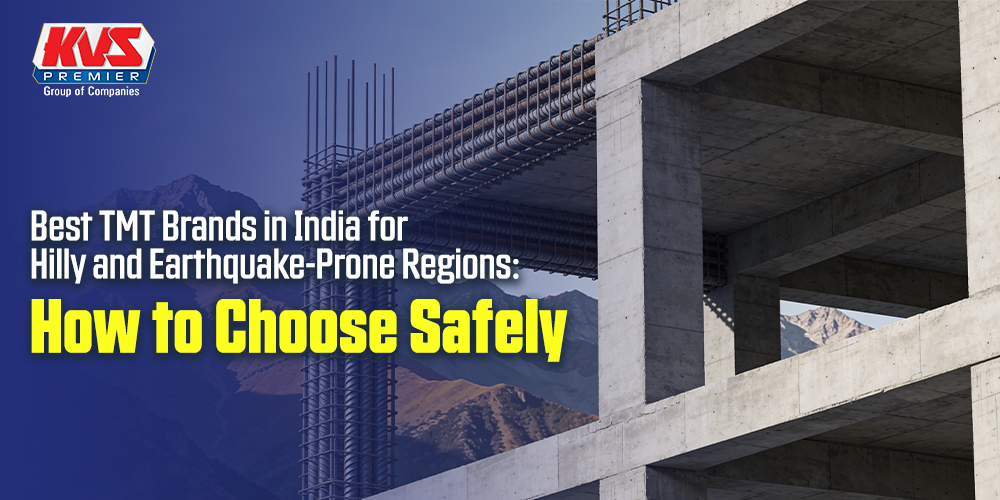
Picture two buildings standing side by side on a Himalayan slope. Same design, same height, same contractor. When the ground shakes, one sways, bends, and survives. The other cracks and fails.
What separated them? Very often, the answer is hidden inside the walls: the steel.
If you are building a home, hotel, school, or commercial project in the hills of Uttarakhand, Himachal, Sikkim, the Northeast, or anywhere in Seismic Zones IV and V, choosing rebar is not a price decision. It is a safety decision. This guide shows you how to choose the Best TMT Brands in India for tough terrain, without getting lost in jargon.
Why Hilly and Earthquake-Prone Regions Need Smarter Steel
Plain-land construction mostly deals with vertical loads, meaning the weight of the building pressing down. Hills and seismic zones add a nasty extra: lateral, repeating, unpredictable forces.
Here is what your steel faces in these regions:
- Earthquake shaking: Sideways and up-and-down forces that push beams and columns beyond normal limits.
- Slope pressure: Retaining walls and foundations carry soil thrust that flat-land buildings never feel.
- Moisture and temperature swings: Rain, fog, snow, and freeze-thaw cycles speed up corrosion.
- Landslide-prone soil: Foundations may move slightly over time, stressing the structure.
Concrete is strong in compression but weak when stretched or bent. Steel does that job. So when the earth moves, the reinforcement decides whether your building bends safely or breaks suddenly.
Why Ductility Is the Real Hero
Most buyers ask, “How strong is this bar?” In earthquake country, a better question is, “How well does this bar bend without snapping?”
That quality is called ductility. A ductile bar stretches, absorbs energy, and gives occupants warning time and a chance to escape. A brittle bar fails without notice.
Think of a paper clip. Bend it once and it holds. Bend it back and forth too far and it snaps. Good seismic steel is engineered to handle that stress cycle far longer.
This is why the Best TMT Brands in India for seismic regions focus on controlled chemistry, consistent heat treatment, and ductility, not only headline strength numbers.
The Grades That Matter: Fe 500D and Fe 550D
When you shop for TMT bars for earthquake-prone areas, grade names tell you a lot.
- Fe 500: Suits standard residential construction in low-risk zones. It offers good strength but only basic ductility.
- Fe 500D: Built for hills and Seismic Zones III to V. The “D” stands for enhanced ductility, with better elongation and strength ratios.
- Fe 550D: Meant for high-rise buildings, bridges and heavy structures. It combines higher strength with ductility, so you can often use less steel for the same load.
Rule of thumb: If your site is in Seismic Zone IV or V, or on a steep slope, make Fe 500D your minimum. Ask your structural engineer whether Fe 550D suits your design.
Look for compliance with IS 1786, the Bureau of Indian Standards specification for high-strength deformed steel bars. For seismic design, your engineer will also follow IS 1893 (earthquake-resistant design) and IS 13920 (ductile detailing).
How Good TMT Bars Are Made (and Why It Matters)
TMT stands for Thermo-Mechanically Treated. The process is simple to describe and hard to do well:
- Hot steel bars are rolled and shaped.
- They are rapidly cooled with water, which hardens the outer layer.
- The core stays softer and ductile, then the bar self-tempers as heat flows outward.
The result is a hard outer shell and a tough, flexible core. That combination gives you strength and bendability in one bar.
Here is the catch. Not every manufacturer controls this process equally. Weak quenching control produces uneven rings, inconsistent strength, and poor ductility. That is why looking at the maker matters as much as looking at the grade. Any serious TMT company in India worth trusting will openly share test certificates, chemical composition, and batch traceability.
7-Point Checklist: How to Choose Safely
Before you place an order, run through this list. It takes ten minutes and could protect decades of safety.
- Confirm BIS certification. Look for the ISI mark and a valid BIS license number on the bar or bundle tag. No mark means no deal.
- Insist on the “D” grade. For seismic and hill projects, Fe 500D or higher is the safe baseline.
- Check elongation and the UTS/YS ratio. Ask for the mill test certificate (MTC). Better ductility shows up as higher elongation and a healthy tensile-to-yield strength ratio.
- Look for low carbon equivalent. A controlled carbon equivalent makes bars more weldable and less brittle. This matters when lapping and joining on site.
- Inspect the rib pattern and surface. Uniform ribs improve grip with concrete. Avoid bars with cracks, heavy rust flakes, or uneven diameter.
- Ask about corrosion protection. Hilly regions are damp. If your project is near rainfall belts, snowfall zones, or coastal air, consider corrosion-resistant TMT options.
- Verify batch traceability and weight tolerance. Reputable producers mark batches and keep bar weight within tolerance. Under-weight bars mean you are paying for steel you do not get.
Common Mistakes People Make in Hilly Construction
Even smart buyers slip up. Watch out for these:
- Buying by price per kg alone. A cheaper bar that is underweight or low-grade can cost far more in repairs.
- Mixing grades on one project. Different grades behave differently under load. Stick to the engineer’s specification.
- Ignoring bar storage. Leaving steel in mud or rain for weeks invites rust before it is even used.
- Skipping site testing. For larger projects, test a sample batch at an accredited lab.
- Relying only on claims. Check the BIS mark, grade and test certificate before you buy, so you know exactly what goes into your building.
So, What Makes the Best TMT Brands in India for Tough Terrain?
Forget flashy advertising. The Best TMT Brands in India for hills and seismic regions share a few quiet traits:
- Consistent Fe 500D / Fe 550D production with certified test reports
- Tight control over quenching and self-tempering
- Strong ductility and elongation values, not only high yield strength
- Corrosion resistance suited to humid and cold climates
- Transparent quality testing at every batch
- Reliable supply and dealer support, even in remote locations
Many buyers also search for the best TMT brands in India by region. Local availability matters in the hills, because delivery delays and poor storage can quietly affect quality. A manufacturer with a dependable distribution network is a real advantage.
Quick Tips for Builders in High-Risk Zones
- Design first, buy second. Share your soil report and seismic zone with your structural engineer before selecting steel.
- Detail matters. Even the best steel fails if stirrups are widely spaced or lap lengths are wrong. Ductile detailing per IS 13920 is non-negotiable.
- Use quality cover blocks. Proper concrete cover protects bars from moisture over the years.
- Supervise bending and fixing. Cold bending should follow standard mandrel sizes to avoid micro-cracks.
- Keep your documents. Store invoices, test certificates, and BIS details. They help with insurance, resale, and future inspections.
The Bottom Line
Building in the hills is a beautiful dream. Building it safely is a responsibility. Earthquakes cannot be predicted, but their effect on your structure can be reduced with the right design, careful workmanship, and the right steel.
When you compare TMT brands in India, look beyond the logo. Read the grade, ask for test reports, check certification, and match the steel to your terrain. A trustworthy TMT company in India will welcome those questions, not avoid them.
Choose steel that bends before it breaks, and your building will keep its promise to the family inside.
Planning a project in a hilly or seismic region?
Talk to the KVS Premier team for guidance on the right grade, documentation, and supply for your site.
Frequently Asked Questions (FAQs)
1. Which TMT grade is best for earthquake-prone areas in India?
Fe 500D is the commonly recommended minimum for Seismic Zones III to V, thanks to its higher ductility. Fe 550D suits larger or heavier structures when your structural engineer approves it. Always confirm with your designer based on your soil report and seismic zone.
2. What does the “D” in Fe 500D mean?
The “D” stands for ductility. These bars offer higher elongation and a better tensile-to-yield strength ratio, which helps them absorb earthquake energy and bend without snapping suddenly.
3. How can I identify genuine, good-quality TMT bars?
Check for the ISI mark and BIS license number, uniform rib patterns, correct weight and diameter, and a clean surface without cracks. Ask for the mill test certificate showing chemical and mechanical properties for your specific batch.
4. Do hilly regions need corrosion-resistant TMT bars?
Often, yes. Humidity, heavy rain, snow, and temperature swings speed up rusting. Corrosion-resistant bars and proper concrete cover extend a structure’s life, especially in coastal-influenced or high-rainfall hill areas.
5. How do I choose among the Best TMT Brands in India without being misled by marketing?
Compare certifications, grade, test reports, ductility values, batch traceability, and distribution support, not advertising claims. Ask for documents, check weight tolerance, and consult your structural engineer before finalising your purchase.